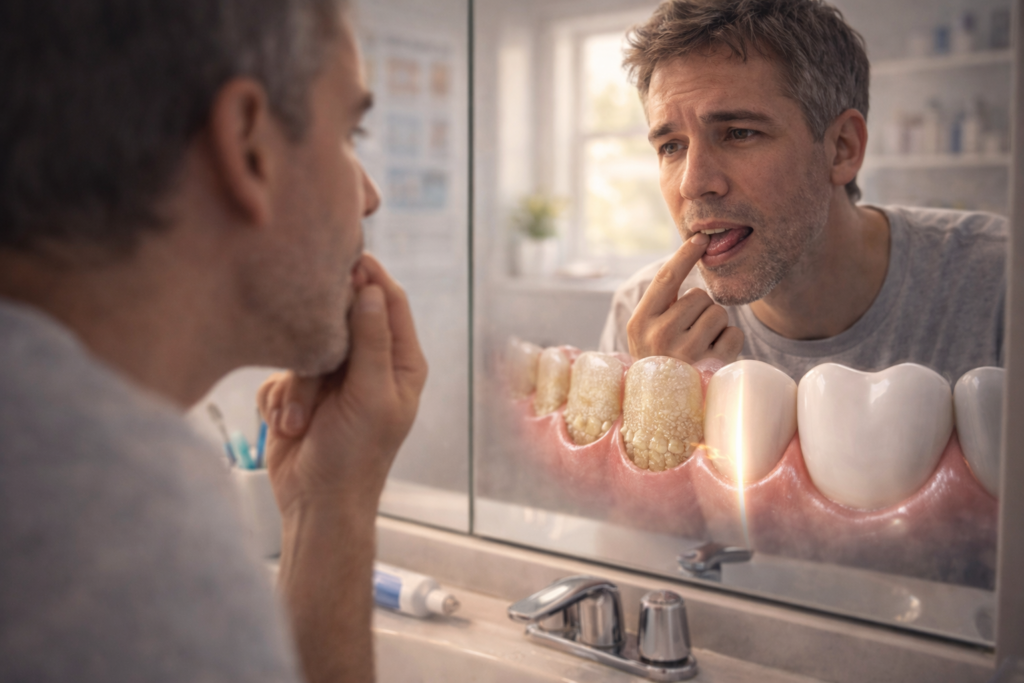
It usually happens at the quietest moments.
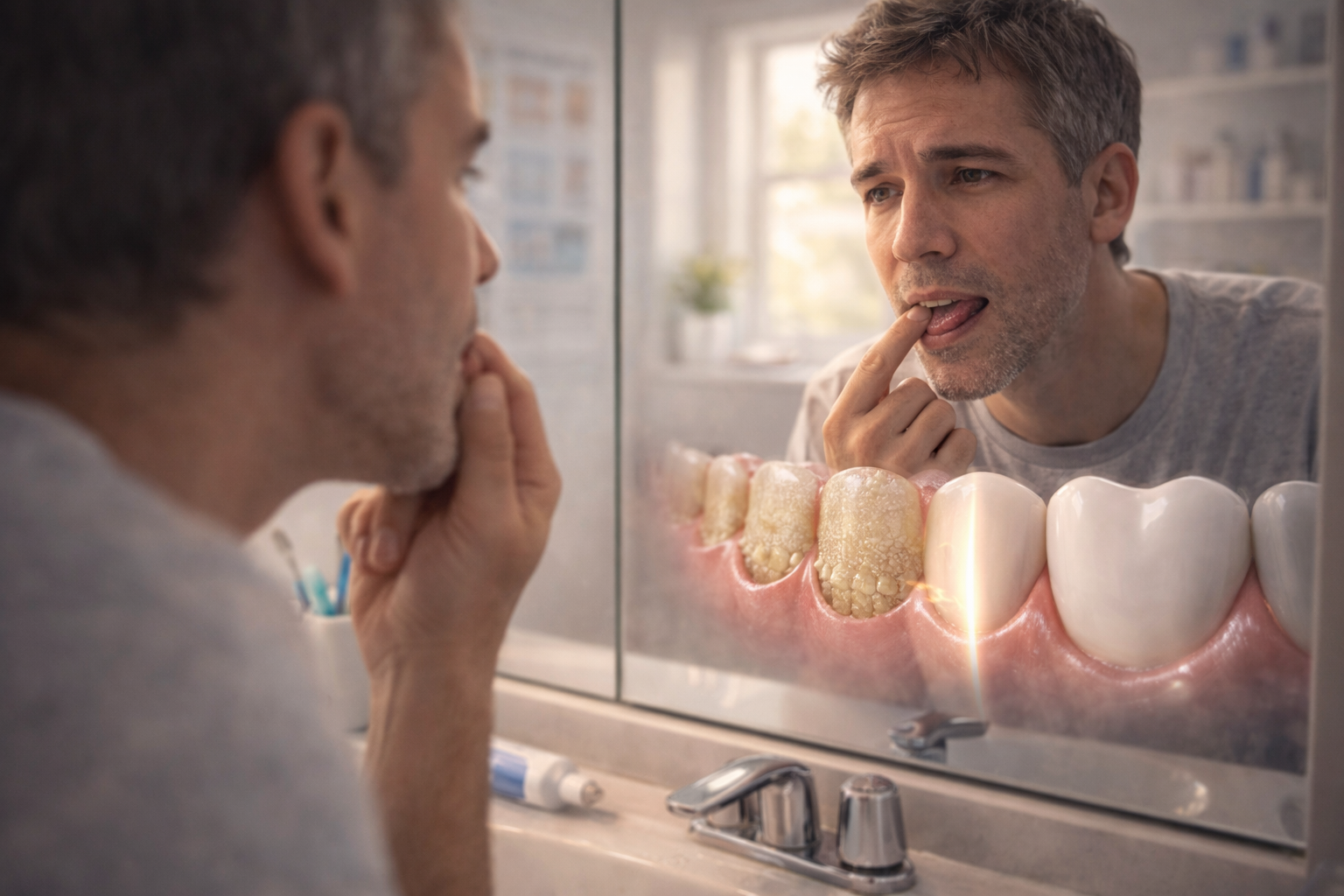
You’re not thinking about your teeth. You’re not standing in front of a mirror or sitting in a dental chair. Maybe you’re just lying in bed, scrolling through your phone, or staring at the ceiling after a long day. And then, almost without realizing it, your tongue drifts across your teeth.
And something feels… off.
Not painful. Not exactly uncomfortable. Just rough.
At first, you might ignore it. Maybe you tell yourself it’s nothing—just your imagination. But then it happens again the next day. And the day after that. That same slightly gritty, uneven feeling, like your teeth aren’t as smooth as they used to be.
I remember the first time I noticed it clearly. It was early in the morning, right after I woke up. I hadn’t brushed yet, and when my tongue moved across my teeth, it felt like I’d run it over a chalkboard that had been lightly dusted with sand.
That’s when the question started forming:
Why do my teeth feel like this?
It’s Not Just “Dirty Teeth”
Most people assume the answer is simple: you didn’t brush well enough.
And sometimes, that’s part of it. But the real reason is a little more interesting—and a lot more gradual.
Your teeth don’t suddenly become rough overnight. What you’re feeling is usually the result of buildup. A thin, invisible layer that forms constantly, whether you notice it or not.
Dentists call it plaque.
Plaque is a sticky film made up of bacteria, food particles, and saliva. It starts forming on your teeth just hours after you brush. Even if your teeth look clean in the mirror, plaque can still be there, quietly settling into the tiny spaces you can’t easily see.
At first, it’s soft. Almost unnoticeable.
But if it’s not removed properly, it begins to change.
When Soft Turns Solid
Here’s the part most people don’t realize.
Plaque doesn’t just sit on your teeth—it evolves.
If it stays there long enough, it hardens into something called tartar (or calculus). And unlike plaque, tartar isn’t something you can simply brush away.
This is where that rough feeling becomes more noticeable.
Tartar has a harder, uneven texture. It often forms near the gumline or between teeth—places that are easy to miss when brushing. Once it’s there, it creates a surface that attracts even more plaque, making the cycle continue.
That faint roughness you feel with your tongue?
It might be your mouth trying to tell you that something has been building up for a while.
The Places You Miss Without Realizing
I used to think I brushed thoroughly. Two minutes, twice a day. That should be enough, right?
But when my dentist pointed out where buildup tends to hide, it suddenly made sense.
The back teeth. The inner surfaces. The area right along the gums.
These spots are easy to rush through or skip entirely, especially when brushing becomes automatic. You think you’ve covered everything—but your toothbrush might disagree.
And your tongue definitely notices.
That’s the strange thing about it. Your eyes might not see anything unusual. Your teeth can still look white. But your tongue is far more sensitive to texture than your eyes are to subtle changes.
It’s like your mouth has its own way of checking your work.
Morning Roughness vs. All-Day Roughness
There’s also a difference between when you feel that roughness.
If your teeth feel rough only in the morning, it’s usually because plaque has had all night to build up. While you sleep, your mouth produces less saliva, which means there’s less natural cleaning happening.
That’s normal.
But if your teeth still feel rough even after brushing, that’s when it becomes more telling.
It could mean:
- You’re missing certain areas
- You’re not brushing effectively
- Or tartar has already formed
That was the moment I started paying closer attention—not just to whether I brushed, but how I brushed.
The Illusion of Clean
One of the most surprising things I learned is how easy it is to feel “clean” without actually being clean.
Toothpaste helps create that fresh, minty sensation we associate with cleanliness. It’s satisfying. Reassuring, even.
But that feeling doesn’t always reflect reality.
You can finish brushing, rinse your mouth, and feel like everything is fine—only to run your tongue across your teeth and notice that same uneven texture still there.
That’s because brushing isn’t just about spreading toothpaste around. It’s about physically removing buildup.
And that takes intention.
The Role of Technique (More Than You Think)
When I started adjusting how I brushed, the difference wasn’t immediate—but it was noticeable.
Slowing down helped. Paying attention to angles helped even more.
Instead of brushing straight across, I began angling the bristles toward the gumline. I spent a little more time on the areas that felt rough instead of avoiding them.
And gradually, that gritty feeling started to fade.
Not completely at first—but enough to make me realize something important:
It wasn’t about brushing harder. It was about brushing smarter.
When Brushing Isn’t Enough
There’s a point where brushing alone won’t fix the problem.
If tartar has already formed, it needs to be removed professionally. That’s what dental cleanings are for.
I remember sitting in that chair again, hearing the faint scraping sound as the dentist worked along my teeth. It wasn’t painful—just oddly satisfying, like something stubborn was finally being cleared away.
Afterward, I ran my tongue across my teeth without even thinking.
Smooth.
Completely smooth.
It was such a small thing, but it felt like a reset. Like my teeth had been returned to what they were supposed to feel like all along.
Why Your Teeth Matter More Than You Think
That rough feeling might seem like a minor annoyance. Easy to ignore.
But it’s often an early sign—one of the first indicators that something is building up in your mouth.
Left unchecked, it can lead to bigger issues. Gum irritation. Cavities. More serious dental problems over time.
Your mouth doesn’t always send loud warnings.
Sometimes, it whispers.
And that faint, sandy texture on your teeth? That’s one of those whispers.
Learning to Notice the Small Things
What changed for me wasn’t just my brushing technique—it was my awareness.
I started noticing how my teeth felt at different times of the day. After meals. Before brushing. After brushing.
I paid attention to the difference between “clean enough” and actually clean.
And slowly, brushing stopped being something I rushed through.
It became something I understood.
The Real Reason, After All
So what’s the real reason your teeth feel rough?
It’s not just about forgetting to brush.
It’s about the small things that build up over time—the places you miss, the habits you don’t question, the moments you rush through without realizing it.
It’s about how something as simple as brushing your teeth can become so routine that you stop paying attention to it.
And sometimes, all it takes is that one quiet moment—your tongue brushing against your teeth—to remind you that there’s more going on than you thought.
Now, every time I notice that feeling starting to come back, I don’t ignore it.
I see it for what it is: a signal.
Not urgent. Not alarming.
Just a quiet nudge to slow down, pay attention, and take better care of something I use every single day without thinking.
And maybe that’s the real lesson in all of this.
The smallest details are often the ones trying to tell you the most.