If you had told me a few years ago that sound—something invisible, intangible, and often taken for granted—could be used to clean objects more effectively than scrubbing with a brush, I probably would have raised an eyebrow. Cleaning, in my mind, was always about friction: soap, water, effort. The idea that sound waves could do the job felt almost poetic, like something out of science fiction. But the deeper I looked into sonic cleaning, the more I realized that it’s not only real—it’s rooted in some of the most fascinating principles of physics.
Let me take you through what I discovered.
When Sound Becomes a Tool
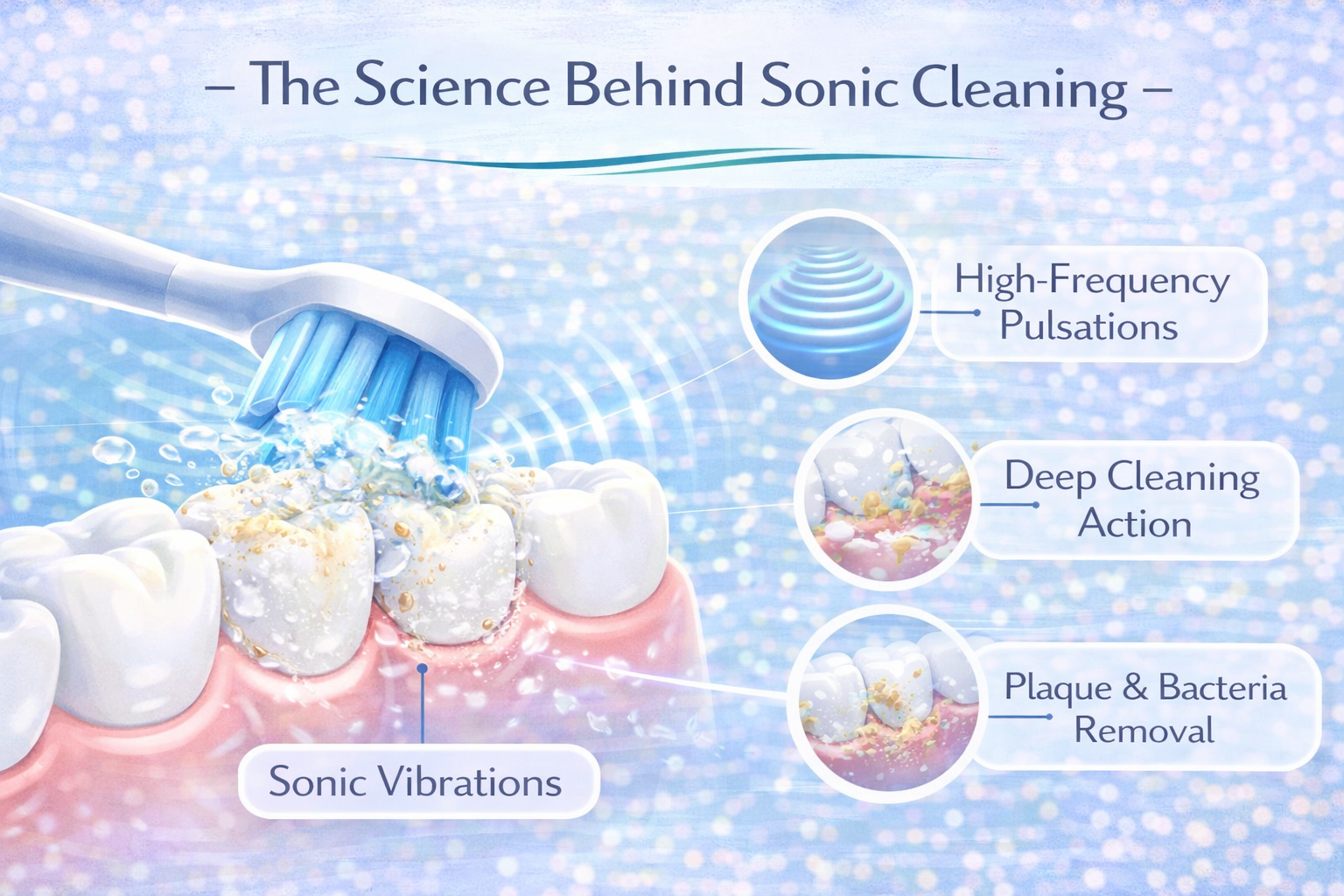
At its core, sonic cleaning relies on high-frequency sound waves, usually in the ultrasonic range—far beyond what our ears can hear. These waves travel through a liquid, typically water mixed with a cleaning solution. But here’s where things get interesting: as the sound waves move through the liquid, they create alternating cycles of high and low pressure.
During the low-pressure phase, tiny vacuum bubbles form in the liquid. This process is called cavitation—a term I had never heard before but quickly grew fascinated by. These bubbles are incredibly small, often microscopic, and they form in massive numbers.
Then comes the high-pressure phase.
The bubbles collapse.
Not gently, not slowly—but violently, at a microscopic level.
Each collapse releases a tiny burst of energy, creating localized jets of liquid and heat. Individually, these bursts are minuscule. But when millions of them occur simultaneously across the surface of an object, they create a powerful cleaning effect that can reach into the tiniest crevices—places no brush or cloth could ever touch.
It’s almost like the object is being cleaned from every angle at once, not by force, but by precision.
A Closer Look at Cavitation
I remember watching a slow-motion simulation of cavitation for the first time. It felt oddly mesmerizing. Bubbles forming, expanding, and then imploding in rapid succession—like a microscopic storm happening beneath the surface.
But beyond the visual fascination lies a deeper scientific explanation.
When these bubbles collapse, they can produce temperatures of several thousand degrees Kelvin and pressures of hundreds of atmospheres, albeit for extremely short durations and within incredibly small spaces. This might sound intense—and it is—but because it happens on such a tiny scale, it doesn’t damage most solid objects.
Instead, it dislodges contaminants: dirt, grease, bacteria, and even oxidation layers.
What surprised me most was how gentle this process can be on delicate items. Jewelry, electronic components, medical instruments—things you’d normally hesitate to scrub—can be cleaned safely using ultrasonic methods. It’s a rare combination: power and delicacy working hand in hand.
Why Frequency Matters
Not all sonic cleaning is created equal. One detail that stood out to me was the importance of frequency.
Lower ultrasonic frequencies (around 20–40 kHz) produce larger cavitation bubbles. These bubbles collapse with more force, making them ideal for removing heavy contaminants like grease or industrial residues.
Higher frequencies (above 80 kHz and beyond) create smaller bubbles, which are less aggressive but more precise. These are better suited for delicate surfaces or intricate designs—think of fine jewelry or sensitive lab equipment.
It made me realize that sonic cleaning isn’t just a one-size-fits-all solution. It’s customizable. You can tune it depending on what you’re cleaning, almost like adjusting the settings on a musical instrument to get the perfect tone.
The Role of the Cleaning Solution
At first, I assumed water alone might be enough. After all, the real action seemed to come from the sound waves. But the cleaning solution plays a crucial supporting role.
Different solutions are formulated to target specific types of contaminants. Some are designed to break down oils and grease, while others focus on removing oxidation or biological residues. The ultrasonic waves enhance the effectiveness of these solutions by ensuring they reach every surface, even the ones hidden from view.
It’s a partnership: the chemistry loosens the dirt, and the physics carries it away.
I found that combination particularly elegant—two different scientific domains working together seamlessly.
Real-World Applications
The more I explored, the more I noticed how widespread sonic cleaning actually is.
Dentists use ultrasonic cleaners to sterilize their tools. Jewelers rely on them to restore the sparkle of rings and necklaces. In laboratories, scientists clean delicate instruments without risking contamination. Even in industries like aerospace and automotive manufacturing, ultrasonic cleaning ensures that components are free from microscopic debris.
And then there are everyday uses. Small ultrasonic cleaners are now available for home use—people use them to clean eyeglasses, watches, and even toothbrush heads.
It’s strange to think that something so advanced has quietly become part of daily life, often without us even realizing it.
The Unexpected Benefits
One thing I didn’t expect was how environmentally friendly sonic cleaning can be.
Because it relies more on physical processes than harsh chemicals, it often reduces the need for strong cleaning agents. Many systems use biodegradable solutions, and the efficiency of the process means less water is required compared to traditional cleaning methods.
There’s also a consistency to it. Unlike manual cleaning, which can vary depending on technique and effort, ultrasonic cleaning delivers uniform results. Every part of the object receives the same level of attention.
It made me think about how much of our traditional approach to cleaning is based on effort—on doing more, scrubbing harder—when sometimes the smarter approach is to let science do the work.
Limitations and Misconceptions
Of course, sonic cleaning isn’t perfect.
It doesn’t magically remove all types of contamination. Heavily encrusted materials may still require pre-cleaning. And certain items—like soft stones or materials with internal cracks—can be damaged if the settings aren’t chosen carefully.
There’s also a common misconception that “stronger is always better.” But in reality, using too low a frequency (and therefore too much القوة at the microscopic level) can harm delicate objects.
It’s a reminder that even the most advanced tools require understanding. Technology works best when we respect its nuances.
A Personal Reflection
What stayed with me the most wasn’t just the science—it was the shift in perspective.
Sonic cleaning challenged the way I think about effort and effectiveness. It showed me that sometimes the most powerful solutions are the ones we can’t see. That precision can outperform force. And that innovation often comes from looking at familiar problems—like cleaning—through an entirely different lens.
There’s something almost philosophical about it.
We tend to associate progress with bigger, faster, stronger. But here, progress is quieter—literally. It operates beyond our senses, in frequencies we cannot hear, using forces we cannot feel directly.
And yet, its impact is undeniable.
The Future of Sonic Cleaning
As technology continues to evolve, I can’t help but wonder where sonic cleaning will go next.
Researchers are already exploring ways to combine ultrasonic waves with other technologies, like nanotechnology and advanced materials, to create even more efficient cleaning systems. There’s potential for applications in medicine, such as non-invasive cleaning of wounds or sterilization techniques that reduce the need for harsh chemicals.
Even in space exploration, where traditional cleaning methods are impractical, ultrasonic systems could play a role in maintaining equipment.
It’s exciting to think that something as simple as sound—a fundamental part of our everyday experience—could hold the key to so many future innovations.
Closing Thoughts
If there’s one thing I’ve learned from diving into the science of sonic cleaning, it’s this: the world is full of hidden mechanisms quietly shaping our lives.
We don’t hear ultrasonic waves. We don’t see cavitation bubbles forming and collapsing. But their effects are real, measurable, and incredibly useful.
And maybe that’s the most beautiful part of it.
Not everything powerful needs to be loud. Not everything effective needs to be visible.
Sometimes, the most remarkable transformations happen just beneath the surface—carried by waves we’ll never hear, doing work we’ll never see, but benefiting from all the same.