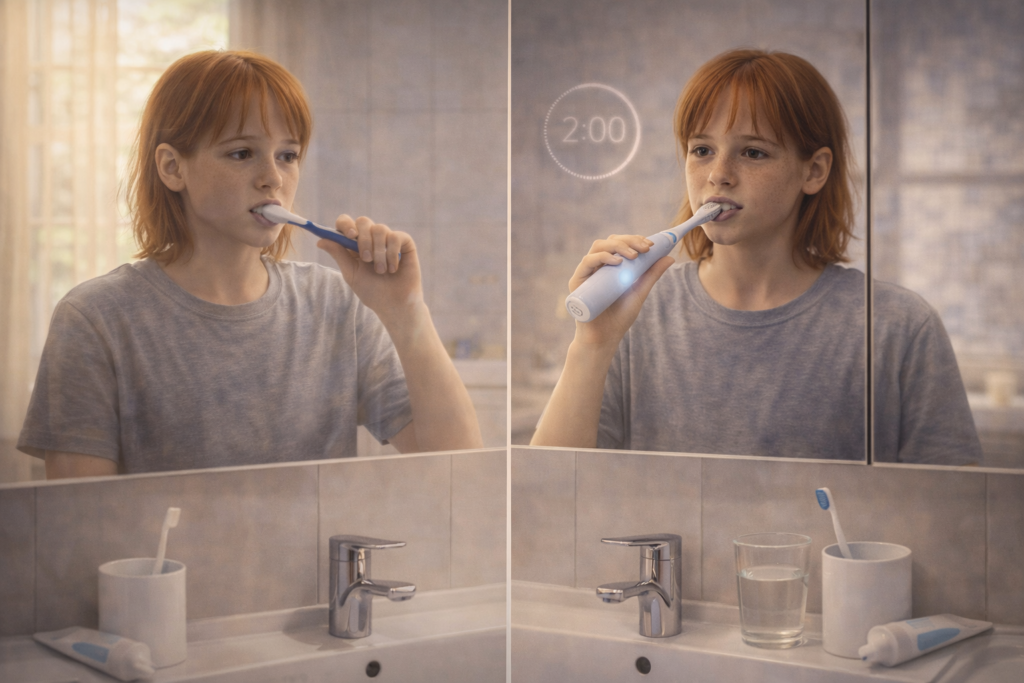
I didn’t expect a toothbrush to become a real decision in my life.
For years, it was automatic. Grab whatever was on sale at the supermarket—usually a pack of three manual toothbrushes in bright colors—and call it a day. Simple, cheap, done. I never questioned it. A toothbrush was a toothbrush… right?
That changed the day I stood in the dental care aisle a little longer than usual.
On one side, the familiar rows of manual brushes. On the other, sleek electric toothbrushes—some with glowing indicators, some promising “3D cleaning action,” others with price tags that made me hesitate. It felt less like shopping and more like choosing a piece of technology.
And suddenly, a simple question started to bother me:
Was I missing out on something important?
The First Time I Tried an Electric Toothbrush
I still remember the first time I used one.
It felt… strange.
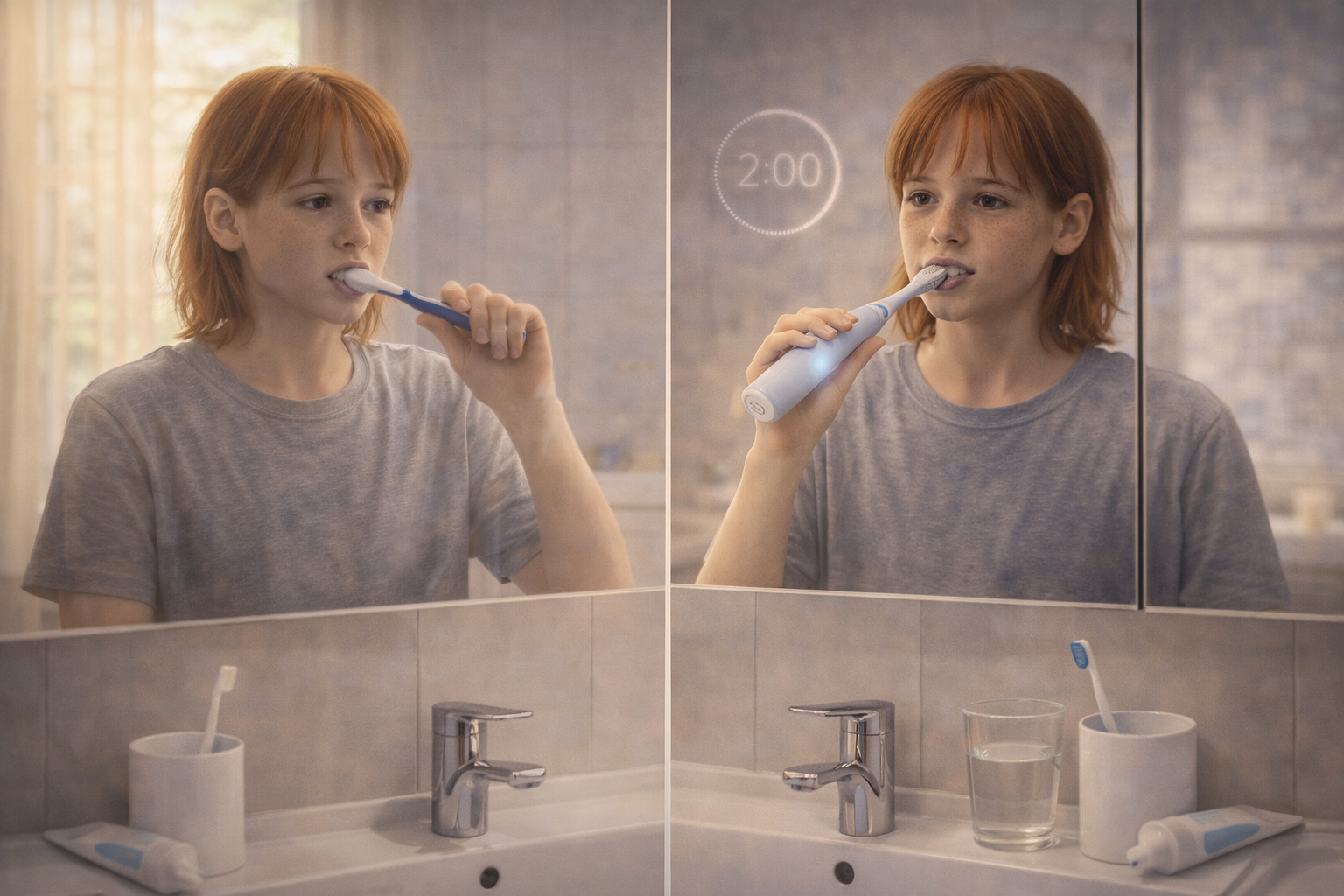
The vibrations were stronger than I expected, almost ticklish at first. I wasn’t sure if I was supposed to move it like a normal toothbrush or just let it sit there. The sound alone made it feel like I was doing something more advanced than brushing my teeth.
But after those two minutes—guided by the built-in timer—I noticed something different.
My teeth didn’t just feel clean. They felt polished.
It was subtle, but noticeable enough to make me pause in front of the mirror for a second longer.
Was it actually better? Or was I just impressed by the novelty?
What “Better” Really Means
That’s when I realized something important: when we ask “Which is better?” we’re usually asking the wrong question.
Better in what way?
- Better at removing plaque?
- Better for your gums?
- Easier to use?
- More worth the money?
Dentists don’t usually give a dramatic answer like, “Electric is the only way.” Instead, they tend to say something more nuanced:
Both can work. But how you use them matters more than what you choose.
Still… there are differences. And they’re worth understanding.
The Case for Manual Toothbrushes
There’s something comforting about a manual toothbrush.
It doesn’t buzz. It doesn’t need charging. It doesn’t come with instructions or settings. You pick it up, you brush, you’re done.
And for many people, that simplicity is exactly what makes it effective.
Manual toothbrushes give you full control. You decide the pressure, the speed, the angle. If you’ve learned proper technique—gentle strokes, the right angle toward the gums, enough time spent on each section—you can clean your teeth just as effectively as with an electric one.
They’re also affordable. You can replace them regularly without thinking twice, which is actually important. A worn-out toothbrush—manual or electric—doesn’t do its job well.
But here’s the catch.
That same freedom and simplicity can also be a downside.
Because when you’re in control of everything… it’s easier to get it wrong.
The Hidden Mistakes We Don’t Notice
When I used a manual toothbrush, I thought I was doing a pretty good job.
Two minutes? Check.
All areas covered? I think so.
Brushing twice a day? Most of the time.
But when I really paid attention, I noticed small things:
I brushed harder than I should have.
I rushed certain areas—especially the back teeth.
I didn’t always keep a consistent rhythm.
None of these felt like big mistakes. But over time, they add up.
That’s where electric toothbrushes quietly step in.
What Electric Toothbrushes Do Differently
The biggest difference isn’t just that they move—it’s how they move.
Electric toothbrushes use consistent, repetitive motions that are hard to replicate by hand. Some rotate, some vibrate, some do both. The point is, they maintain a level of precision and consistency that doesn’t depend on your mood, energy, or attention span.
And then there are the small features that don’t seem important—until they are.
Timers, for example.
I used to think I brushed for two minutes. But when I switched to an electric toothbrush with a timer, I realized I had been stopping early more often than I thought.
Pressure sensors are another one. If you press too hard, the brush alerts you. It’s a simple feature, but it prevents a mistake many people don’t even realize they’re making.
In a way, electric toothbrushes act like a quiet guide. They don’t just clean your teeth—they help you build better habits.
But Are They Actually More Effective?
This is the part most people care about.
Studies generally show that electric toothbrushes can remove slightly more plaque and reduce gum inflammation more effectively over time compared to manual brushes.
But—and this is important—it’s not a dramatic difference.
It’s not like manual brushing doesn’t work. It does. Very well, if done correctly.
The advantage of electric toothbrushes is consistency. They reduce the chances of human error.
So the real question becomes:
Are you confident in your brushing technique every single day?
If the answer is yes, a manual toothbrush might be all you need.
If the answer is “I’m not sure,” an electric toothbrush might help more than you think.
The Cost Question
Let’s be honest—electric toothbrushes are more expensive.
Not just the initial purchase, but also the replacement heads.
And that raises a fair concern: is it worth it?
For some people, the answer is no. A well-used manual toothbrush, replaced regularly, can absolutely maintain good oral health.
But for others, the added cost feels justified.
If it helps you brush longer, more gently, and more consistently… it’s not just a gadget. It’s a tool that improves your daily routine.
It’s less about the price, and more about the value it adds to your habits.
Who Might Benefit Most from Electric Toothbrushes?
As I learned more, I started to see that electric toothbrushes aren’t for everyone—but they can be especially helpful in certain situations.
If you tend to brush too hard, the pressure sensors can protect your enamel and gums.
If you get bored or distracted while brushing, the timers keep you on track.
If you’re wearing braces or have trouble reaching certain areas, the consistent motion can make cleaning easier.
And if you’ve ever wondered whether you’re brushing “well enough,” the extra guidance can give you some peace of mind.
So… Which One Is Better?
After trying both, reading more, and paying attention to my own habits, I came to a simple conclusion:
There isn’t a universal “better” option.
There’s only what works better for you.
Manual toothbrushes are simple, effective, and accessible.
Electric toothbrushes are consistent, supportive, and slightly more advanced.
Neither one is magic. Neither one replaces good technique.
But one might fit your lifestyle a little better than the other.
What I Chose (And Why)
In the end, I stuck with the electric toothbrush.
Not because it was dramatically better—but because it made things easier.
It helped me slow down.
It reminded me not to press too hard.
It made brushing feel less like a chore and more like a routine I could trust.
But I also know this: if I went back to a manual toothbrush tomorrow, I’d still be okay.
Because now I understand what actually matters.
The Real Takeaway
If there’s one thing this whole experience taught me, it’s this:
The best toothbrush isn’t the most expensive one or the most advanced one.
It’s the one you use properly, consistently, every single day.
That’s what dentists really care about.
Not the brand. Not the technology.
Just the habit.
And maybe that’s why such a simple question—manual or electric—doesn’t have a simple answer.
Because in the end, it’s not really about the toothbrush at all.
It’s about you.