I used to believe that tooth decay was something that happened slowly—so slowly, in fact, that you’d always see it coming.
A dull ache. A visible hole. Maybe a warning from your dentist during a routine check-up.
But that wasn’t how it happened for me.
For a long time, everything felt normal. I brushed most days, skipped flossing more often than I’d like to admit, and told myself that avoiding too much sugar was “good enough.” There was no pain, no obvious signs that anything was wrong.
Until one day, there was.
It started with a strange sensitivity—nothing dramatic, just a quick, sharp feeling when I drank something cold. It disappeared as quickly as it came, so I ignored it. A few days later, it happened again. Then again.
That’s when I began to wonder: how fast does tooth decay actually develop?
The Illusion of “Sudden” Damage
Tooth decay can feel like it appears overnight, but the truth is more complicated.
What seems sudden is usually the result of weeks, months, or even years of gradual damage. The early stages of decay are almost invisible. There’s no pain, no clear warning sign—just microscopic changes happening on the surface of your teeth.
It begins with plaque, that sticky film you can sometimes feel if you run your tongue along your teeth at the end of the day. Inside that plaque are bacteria that feed on sugars and carbohydrates from the food you eat.
As they break down these sugars, they produce acids.
And those acids? They slowly weaken your enamel—the hard, protective outer layer of your teeth.
This process is called demineralization.
At first, your body can fight back. Saliva helps neutralize acids and repair early damage through remineralization. But when the balance tips—when acid attacks happen more often than your mouth can recover—decay starts to win.
How Fast Is “Fast,” Really?
Here’s the honest answer: it depends.
Tooth decay doesn’t follow a strict timeline. For some people, it can take years for a cavity to form. For others, it can progress much more quickly—sometimes within months.
I didn’t realize how many factors were involved until I started paying attention.
Your diet plays a huge role. Frequent snacking, especially on sugary or starchy foods, feeds the bacteria constantly. It’s not just how much sugar you eat—it’s how often you expose your teeth to it.
Your oral hygiene habits matter just as much. Skipping brushing or flossing gives plaque more time to sit on your teeth, producing acid without interruption.
Even things like saliva matter. Some people naturally produce less saliva, which means less protection against decay.
Looking back, I realized it wasn’t one big mistake that caused the problem—it was a pattern of small habits.
The Stages You Don’t Notice
One of the most surprising things I learned is that tooth decay happens in stages, and the early ones are easy to miss.
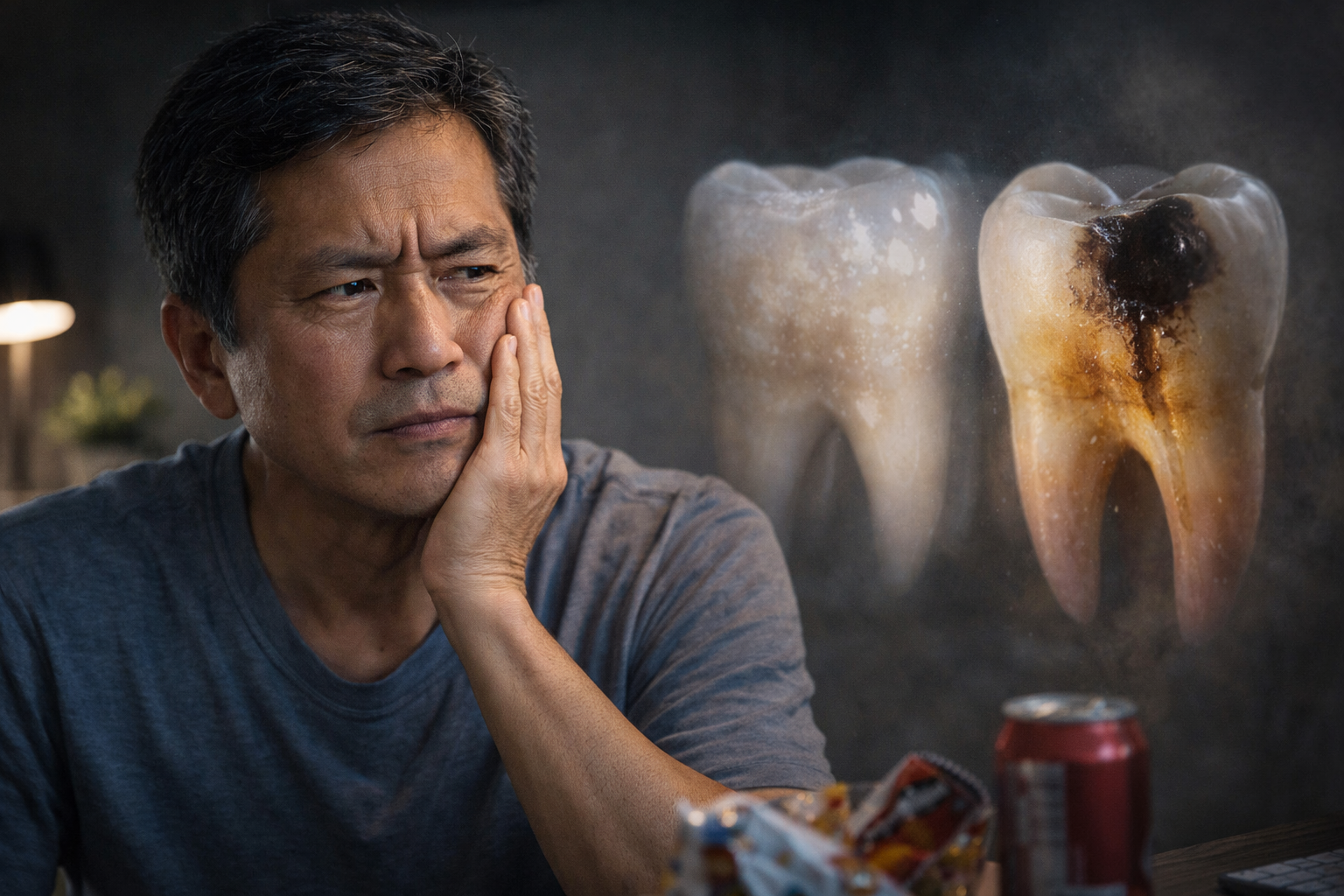
At first, you might see a faint white spot on your tooth. It doesn’t hurt. It doesn’t feel different. But it’s a sign that minerals are being lost from the enamel.
If the process continues, that spot can darken and turn into a cavity—a small hole in the tooth.
This is when things start to become more noticeable. You might feel sensitivity to hot, cold, or sweet foods. Still, it’s easy to brush it off, especially if the discomfort comes and goes.
But decay doesn’t stop on its own.
If left untreated, it moves deeper into the tooth, reaching the dentin—the layer beneath the enamel. This part is softer, which means decay can spread faster once it gets there.
Eventually, it can reach the pulp, where nerves and blood vessels are located.
That’s when the pain becomes impossible to ignore.
Why It Feels Like It Happens Overnight
I remember the exact moment it hit me.
I was eating something I’d had a hundred times before—nothing unusual, nothing extreme. But this time, there was a sharp pain that made me stop mid-bite.
It felt sudden, almost unfair.
How could something go from “fine” to “painful” so quickly?
But the truth is, it didn’t.
The damage had been building quietly for a long time. I just hadn’t noticed the earlier signs—or I had noticed them and chosen to ignore them.
That’s the tricky part about tooth decay. It doesn’t demand your attention until it reaches a point where it can’t be ignored.
The Role of Daily Habits
If there’s one thing that determines how fast tooth decay develops, it’s consistency.
Not perfection—consistency.
Brushing your teeth thoroughly twice a day removes plaque before it can cause harm. Flossing clears out the spaces between your teeth where bacteria love to hide.
But when those habits slip, even just a little, it creates an opportunity for decay to begin.
I used to think missing one night of brushing didn’t matter. And on its own, it probably doesn’t.
But habits aren’t about single moments—they’re about patterns.
Miss one night, then another, then skip flossing for a week, and suddenly you’ve given bacteria exactly what they need: time.
Diet: The Hidden Accelerator
Another thing I underestimated was how much my eating habits affected my teeth.
It wasn’t just about obvious sweets like candy or soda. It was the constant snacking—chips, crackers, even seemingly “healthy” foods that still broke down into sugars.
Every time you eat, especially carbohydrates, your mouth enters an acidic state for a while.
If you’re snacking frequently, your teeth spend more time under acid attack and less time recovering.
That’s how decay can speed up.
It’s not always about eating a lot of sugar at once—it’s about giving your teeth a break in between.
When Time Works Against You
The longer tooth decay goes untreated, the faster it can progress.
Once the enamel is compromised and decay reaches the dentin, things tend to move more quickly. The tooth structure is softer, and bacteria can spread more easily.
At that point, what might have been a simple fix—like a small filling—can turn into something more serious, like a root canal.
And that’s where time really matters.
Delaying treatment doesn’t just prolong the problem—it often makes it more complicated and more costly.
A Shift in Perspective
After going through it myself, I stopped thinking of tooth decay as something distant or unlikely.
It’s not rare. It’s not dramatic—at least not at first.
It’s quiet, gradual, and incredibly common.
And most importantly, it’s preventable.
That realization changed how I approached my daily routine. Brushing stopped feeling like a chore and started feeling like a form of maintenance—something small that protects me from much bigger problems down the line.
So, How Fast Does It Really Develop?
If I had to answer the question now, I’d say this:
Tooth decay develops slowly—until it doesn’t.
For a while, it builds quietly, almost invisibly. Then, once it reaches a certain point, it seems to accelerate, making up for lost time.
That’s why it can feel so sudden, even when it’s not.
The Takeaway
If there’s one lesson in all of this, it’s that time matters—but habits matter more.
You can’t always control how quickly decay starts, but you can influence how far it goes.
Pay attention to the small signs. Don’t ignore sensitivity or changes, even if they seem minor. And most importantly, don’t wait for pain to take action.
Because by the time it hurts, the process has already been going on for longer than you think.
And by then, you’re not just preventing decay anymore—you’re trying to catch up with it.