(A personal, story-driven exploration)
I still remember the first time my dentist gently asked, “Are you sure you’re brushing properly?” It wasn’t accusatory, just curious—but it stuck with me. I had always believed I was doing everything right. Twice a day, two minutes each time, careful circles across every tooth. Yet somehow, at every visit, there was always a small reminder that I could do better.
That question lingered in my mind longer than I expected. It made me wonder: if I was following all the “rules,” why wasn’t it enough?
That’s when I first heard about sonic toothbrushes.
A Curious Upgrade
At first, I was skeptical. A toothbrush is a toothbrush, right? How different could it really be? The idea that something vibrating in my hand could outperform years of learned brushing technique felt almost too simple.
But curiosity has a way of pushing us forward.
I decided to try one—not because I thought my routine was terrible, but because I wanted to understand what “better” could look like. The first time I turned it on, I was surprised by how gentle it felt. There was no aggressive scrubbing, no harsh pressure. Just a steady, almost quiet hum and a subtle movement that felt oddly precise.
It didn’t feel like brushing in the traditional sense. It felt… different. And that difference turned out to matter more than I expected.
The Science Beneath the Surface
What I didn’t realize back then was that sonic toothbrushes aren’t just about movement—they’re about creating an entirely different cleaning environment inside your mouth.
Manual brushing relies almost entirely on physical contact. The bristles touch your teeth, and whatever they can reach, they clean. If your angle is off or your motion is inconsistent, certain areas simply don’t get the same attention.
Sonic technology changes that dynamic.
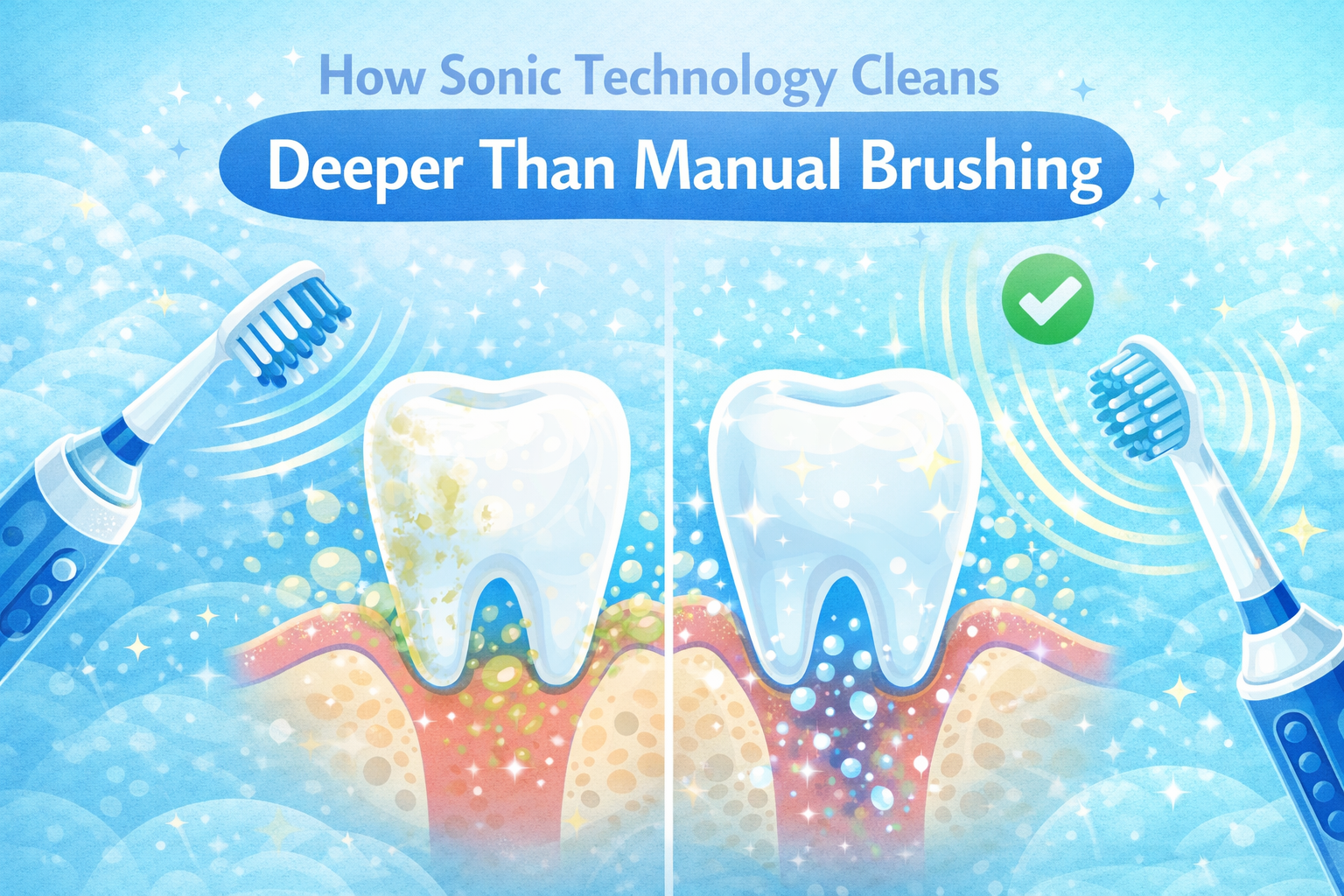
Instead of just scrubbing surfaces, sonic toothbrushes vibrate at incredibly high speeds—often tens of thousands of strokes per minute. But it’s not just about speed. That motion creates something called fluid dynamics: tiny, rapid movements in the mixture of saliva, water, and toothpaste.
Those movements push cleaning action beyond where the bristles physically touch.
It’s like the difference between washing something under still water versus running water. One simply sits there; the other actively carries debris away.
Reaching the Spaces You Can’t See
There’s a moment that really changed my perspective.
A few weeks after switching to a sonic toothbrush, I noticed something subtle: my teeth didn’t just feel clean immediately after brushing—they stayed clean longer. That smooth, polished feeling didn’t disappear halfway through the day like it used to.
At first, I couldn’t explain why. I hadn’t changed my toothpaste. I hadn’t changed my diet. The only difference was the brush itself.
Over time, I realized what was happening.
Manual brushing tends to miss the tiny spaces between teeth and along the gumline—areas where plaque loves to settle. You can try to reach them, of course, but it requires precision, patience, and consistency that most of us don’t maintain perfectly every single day.
Sonic technology helps bridge that gap.
The vibrations generate micro-bubbles and fluid movement that slip into those tight spaces, disrupting plaque even when the bristles aren’t directly there. It’s not magic—it’s physics—but the effect feels surprisingly close to both.
A Gentler Kind of Power
One of the biggest misconceptions I had was that “better cleaning” meant “more force.”
For years, I thought brushing harder meant brushing better. If my gums felt slightly sore afterward, I took it as a sign that I had done a thorough job.
Looking back, that mindset was flawed.
Sonic toothbrushes taught me something important: effectiveness doesn’t come from pressure—it comes from consistency and technique supported by the right tools.
Because the brush does most of the work through rapid motion, you don’t need to press hard. In fact, pressing too hard can reduce its effectiveness. Instead, you guide it slowly across your teeth, letting the vibrations do what they’re designed to do.
This shift—from scrubbing to guiding—felt small at first, but it completely changed my brushing habits.
And surprisingly, my gums felt better too.
Building Better Habits Without Trying Harder
Another unexpected benefit wasn’t just about cleaning—it was about behavior.
Many sonic toothbrushes come with built-in timers, gentle pulses that signal when to move to a different section of your mouth. It sounds like a minor feature, but it subtly reshapes how you brush.
Instead of rushing through the process, you become more aware of time and coverage.
I realized that before, my “two minutes” were often closer to one and a half. Sometimes even less. With the timer guiding me, I wasn’t guessing anymore. I was following a rhythm.
And that rhythm made consistency easier.
It wasn’t about discipline or willpower. It was about having a system that supported better habits without requiring extra effort.
The Difference You Can Feel—and See
After a few months, the changes became more noticeable.
At my next dental visit, the conversation was different. Instead of suggestions for improvement, there was a simple acknowledgment: “Whatever you’re doing, keep doing it.”
It wasn’t a dramatic transformation. There were no overnight miracles. But there was a steady, reliable improvement that built over time.
That’s what made the difference feel real.
Sonic technology didn’t replace good habits—it amplified them. It made each brushing session more effective, even on days when I was tired or distracted.
Why It Matters More Than We Think
It’s easy to underestimate the importance of small daily routines. Brushing your teeth is something you do almost automatically, without much thought.
But those small actions add up.
Every missed spot, every rushed session, every bit of plaque left behind—it all accumulates over time. And often, we don’t notice until there’s a problem.
What sonic technology offers isn’t just a cleaner feeling—it offers a kind of safety net. It helps compensate for the imperfections in our routines.
Because let’s be honest: no one brushes perfectly every single day.
A Subtle Shift in Perspective
If there’s one thing this experience taught me, it’s that improvement doesn’t always come from trying harder. Sometimes, it comes from trying differently.
Switching to a sonic toothbrush didn’t require me to overhaul my life or learn complicated techniques. It simply changed the way the process worked.
And that change—quiet, consistent, and almost unnoticeable at first—made all the difference.
Final Thoughts
Looking back, that question from my dentist wasn’t really about whether I was brushing “right.” It was about whether I was open to doing it better.
Sonic technology isn’t just about advanced features or modern design. It’s about enhancing something we already do every day, making it more effective without making it more difficult.
And in a world where we’re constantly searching for big breakthroughs, sometimes it’s these small, thoughtful improvements that have the greatest impact.
So if you’ve ever wondered whether your brushing routine could be better, the answer might not lie in brushing harder or longer.
It might simply lie in letting technology do what it does best—quietly, consistently, and just beneath the surface.