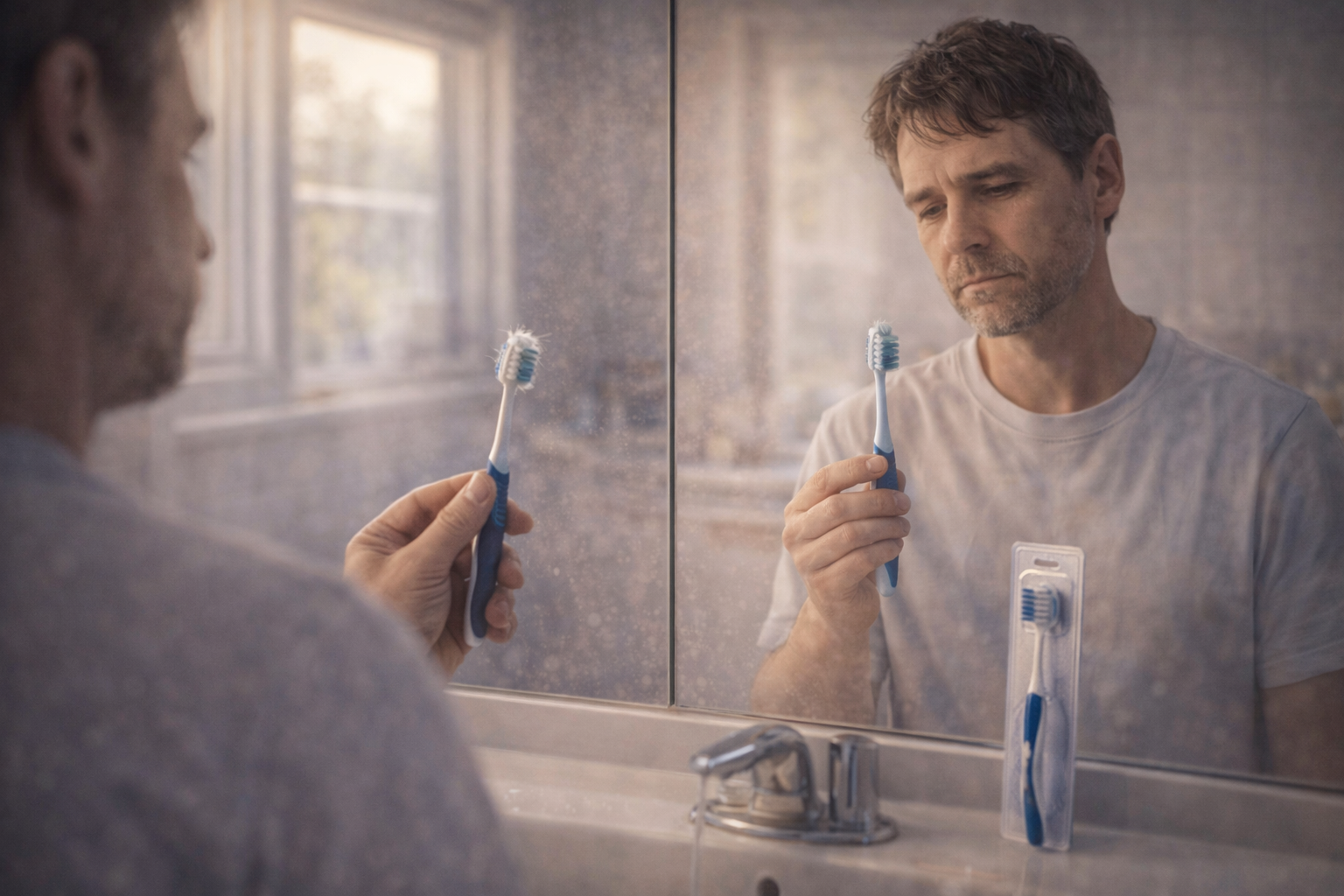
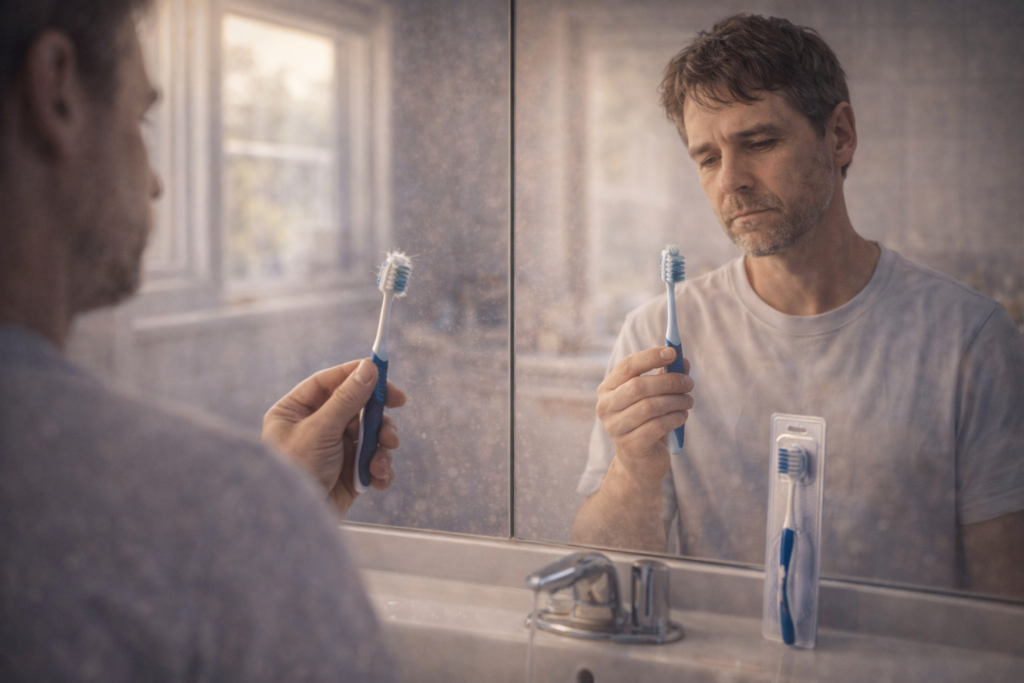
I didn’t think much about my toothbrush—until one morning, I noticed the bristles had started to curl outward like they were trying to escape their own handle.
It wasn’t dramatic. Nothing broke. Nothing fell apart. It just looked… tired.
Still, I kept using it.
There’s something oddly easy about ignoring small things like that. A toothbrush doesn’t beep when it expires. It doesn’t stop working overnight. It just slowly becomes less effective, quietly, almost politely, as if it doesn’t want to inconvenience you.
And that’s exactly why most of us keep using the same one far longer than we should.
The Toothbrush You Stop Noticing
At some point, your toothbrush becomes invisible.
It sits in the same spot. You pick it up half-awake. You go through the motions—left, right, rinse, done. It’s not something you examine closely. It’s part of a routine you don’t question.
That’s what happened to me.
If someone had asked, “How long have you been using that toothbrush?” I probably would have guessed a month. Maybe two.
The reality? I had no idea.
And when you don’t keep track, time stretches.
Weeks turn into months. Months turn into… well, longer than you’d like to admit.
What Dentists Quietly Notice
At my next dental visit, my dentist didn’t even need to ask.
She took one look at my teeth, then casually asked, “When was the last time you changed your toothbrush?”
It wasn’t an accusation. More like a gentle observation.
I hesitated. “Not that long ago,” I said, which, in hindsight, wasn’t really an answer.
She smiled slightly—the kind of smile that says she already knows.
“Most people wait too long,” she said. “You’re not alone.”
That made me feel better for about two seconds… until she explained why it actually matters.
The 3-Month Rule (And Why It Exists)
Dentists usually recommend replacing your toothbrush every three months.
It sounds simple enough. But like most simple advice, there’s more behind it than meets the eye.
Over time, the bristles start to wear down. They lose their shape, their firmness, their ability to reach into the small spaces between your teeth and along your gums.
Even if your toothbrush looks okay at first glance, those tiny changes make a difference.
It’s like trying to sweep a floor with a worn-out broom. You’re still moving it back and forth, but you’re not really picking things up the way you should.
And with your teeth, “not quite effective” isn’t good enough.
The Signs You Shouldn’t Ignore
The three-month rule is a guideline—but sometimes your toothbrush tells you its story earlier.
That’s what mine had been doing all along.
Those frayed, splayed bristles? That’s your first clue.
A toothbrush should have straight, uniform bristles. When they start bending outward, it means they’re no longer cleaning efficiently—and they may even be too harsh on your gums.
Another sign is how it feels.
If brushing starts to feel less precise, less “clean,” or oddly rough in some areas, it might not be your technique—it might be the brush itself.
And then there’s the less obvious factor: what your toothbrush has been through.
After You’ve Been Sick
This was something I had never considered before.
If you’ve been sick—especially with something like a cold, flu, or throat infection—your toothbrush can hold onto bacteria or viruses.
Using the same toothbrush afterward can increase the chance of reintroducing those germs into your body.
That doesn’t mean you need to panic or throw it away every time you sneeze. But after a noticeable illness, replacing your toothbrush is a simple, low-effort way to protect yourself.
It’s one of those small habits that feels unnecessary… until you think about it for more than a few seconds.
The Myth of “It Still Works Fine”
I used to justify keeping my toothbrush with one simple thought:
“It still works.”
And technically, it did. It held toothpaste. It moved across my teeth. It didn’t fall apart.
But that’s a low standard.
A toothbrush isn’t just supposed to “work”—it’s supposed to clean effectively, gently, and thoroughly.
Once the bristles wear down, you’re not getting the same level of care. You might be leaving behind plaque without realizing it. Over time, that can lead to bigger issues—cavities, gum irritation, or worse.
The tricky part is that you won’t notice it immediately.
Like many things in dental health, the consequences build slowly.
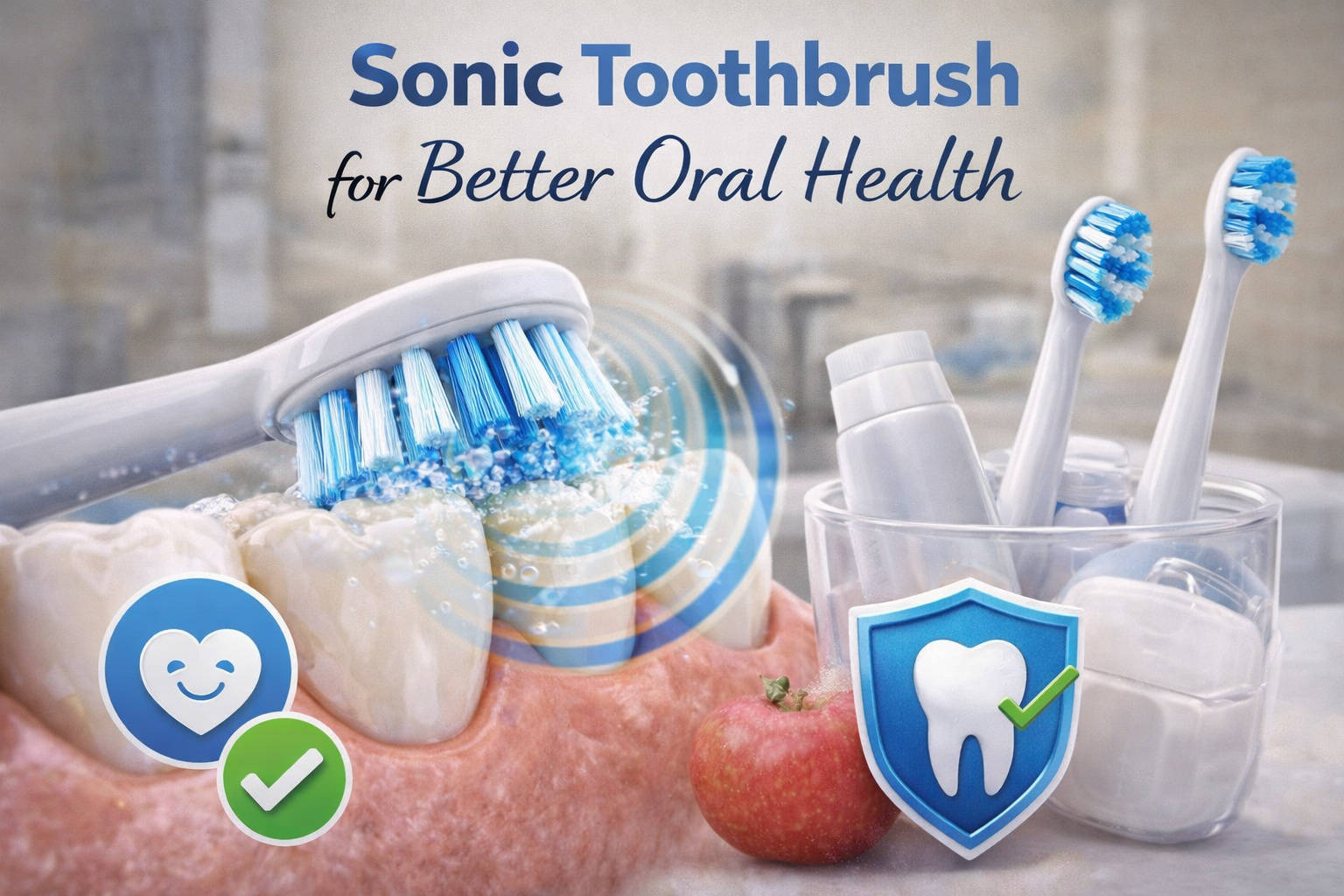
Electric Toothbrush Heads Count Too
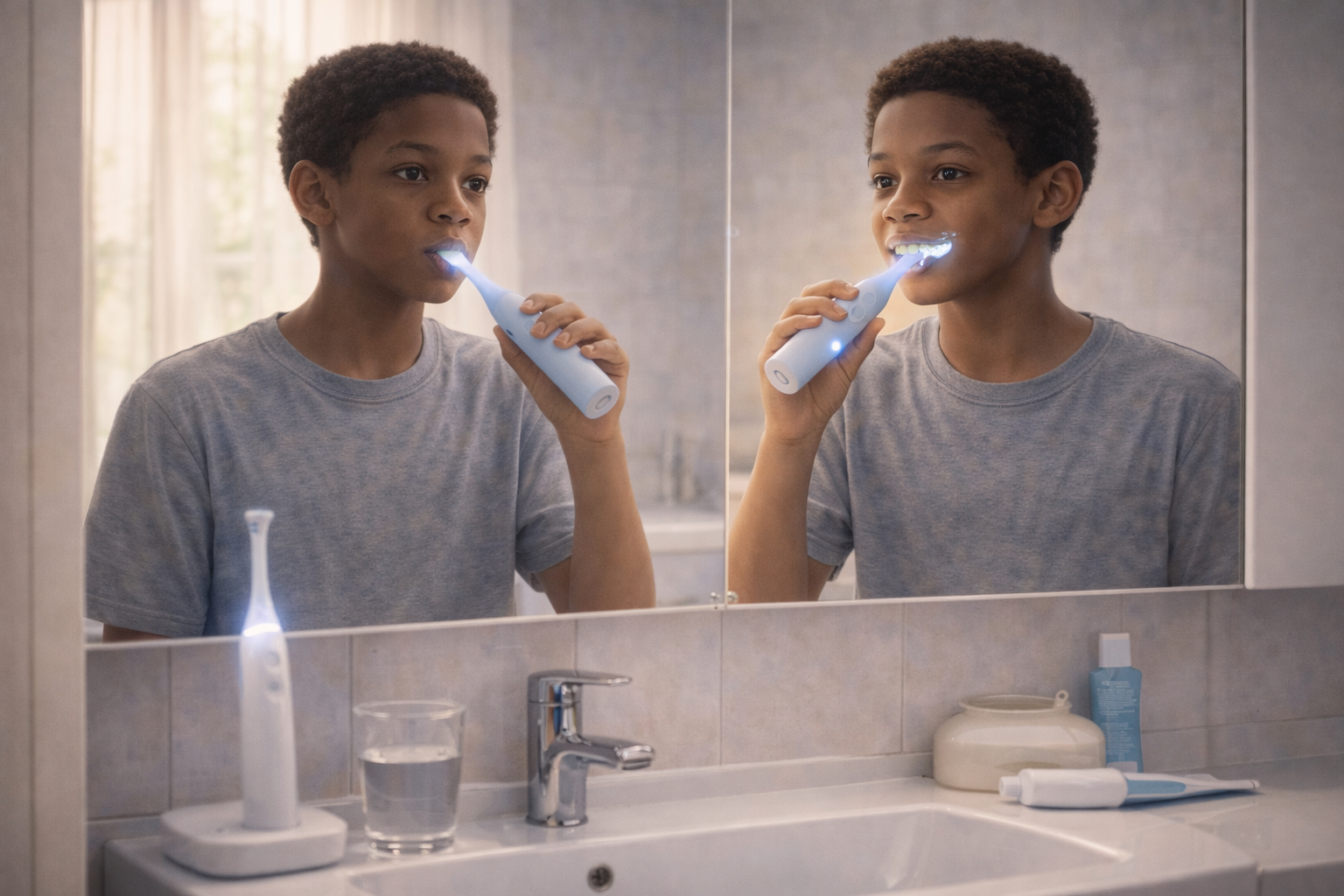
Switching to an electric toothbrush doesn’t mean you can forget about replacing it.
In fact, the same rule applies—replace the brush head every three months, or sooner if the bristles start to wear out.
The difference is that many electric toothbrushes make it easier to remember. Some have indicator bristles that fade in color. Others track usage and send reminders.
It’s a small detail, but it helps turn something easy to forget into something automatic.
The Psychology of Replacement
What surprised me most wasn’t the rule itself—it was how resistant I felt to following it.
Replacing a toothbrush isn’t expensive. It doesn’t take effort. It’s not complicated.
And yet, I kept putting it off.
Why?
Because it didn’t feel urgent.
There’s no immediate consequence. No warning sign that forces you to act right away. It’s easy to think, “I’ll replace it next week,” and then forget.
It’s the same reason we delay other small maintenance tasks in life.
But the truth is, these small things matter precisely because they’re consistent.
Brushing your teeth is something you do every day. That means your toothbrush plays a role in your health every single day too.
Turning It Into a Habit
After that dental visit, I decided to make one small change.
Instead of guessing when to replace my toothbrush, I tied it to something else—something I already pay attention to.
Every three months, at the start of a new season, I replace it.
Spring. Summer. Fall. Winter.
It’s simple, predictable, and easy to remember.
Some people set reminders on their phone. Others replace it on the first day of every third month. There’s no perfect system—just one that works for you.
The Subtle Shift
The next time I picked up a new toothbrush, I noticed something I hadn’t paid attention to before.
It felt… different.
The bristles were firm but gentle. The brushing felt more precise. Cleaner. Like I was actually reaching the places I was supposed to.
It wasn’t a dramatic change. But it was noticeable.
And it made me realize how long I had been brushing with something that wasn’t doing its job properly.
What This Really Comes Down To
Replacing your toothbrush isn’t about following a rule for the sake of it.
It’s about maintaining the quality of something you rely on every day.
We often think of oral health as something complicated—appointments, procedures, unexpected issues.
But a lot of it comes down to small, consistent habits.
And this is one of the simplest ones.
A Question Worth Asking
Now, every time I look at my toothbrush, I find myself asking a quiet question:
“How long have you been here?”
It’s such a small object. Easy to overlook. Easy to forget.
But it’s also something that, in its own quiet way, takes care of you—twice a day, every day.
The least you can do is return the favor.
If you’re not sure when you last replaced yours… that might already be your answer.